Inventor
Researchers, students, labs and independent inventors. No company needed. Tested concept to working prototype; no company formed around the invention yet.
How to take part
Choose one path and one theme. You don't need a company unless you're applying as a Venture.
1
Choose your path and theme
Inventor, Venture or Systems — across four planet-first themes.
2
Apply now
Describe what your invention is, what it changes, and who it affects.
3
Evaluation in waves
Two fellows score each complete entry independently before review by theme juries.
4
Pitch Day and finals
The top 20 pitch online on March 17; all 50 attend. Ten finalists pitch at the Summit.
Global Innovation Challenge 2027
Every entry chooses one path and one theme.
Researchers, students, labs and independent inventors. No company needed. Tested concept to working prototype; no company formed around the invention yet.
Registered companies from pre-seed through Series B, with a pilot, customer or other implementation beyond a deck.
Policy, regulatory, financial and institutional inventions: a written mechanism ready for a first adopter, not yet adopted at scale.
Generation, storage, grids, heat, fuels, electrified mobility, and the minerals and materials energy depends on.
Agriculture, proteins, freshwater, irrigation, soil health and fisheries.
Construction, chemicals, textiles, packaging, waste as feedstock, repair and reuse.
Ecosystem restoration, oceans, forests, animal welfare, carbon and climate stabilization.
Eligibility and evidence
Anyone, anywhere can apply, free of charge. Entries are in English. One entry per invention; Inventor and Systems applicants may submit up to three inventions. Venture founders must work on their startup full time or intend to do so.
A working prototype, lab results or test data, plus conversations with potential users or adopters.
A pilot, paying or committed customer, letter of intent, deployed units or usage data. A deck alone is not enough.
Consultation with people affected and review by a potential jurisdiction, regulator or institutional adopter.
The invention must come from your own research, experience or practice, and the answers must be written by you. AI-generated inventions and AI-written answers are not accepted. AI as an instrument inside the invention — such as modelling or data analysis — is allowed and must be disclosed. A false declaration removes an entry at any stage.
Entries that harm people, communities or animals cannot advance. Confidential details of Inventor and Venture entries stay private; Systems mechanisms may be discussed publicly.
If a material’s main use is in energy technology, choose Energy & Critical Materials. Other materials belong in Materials & Circular Systems. Electrified mobility belongs in energy; it is not a separate theme.
How we select
Every entry is evaluated with the Symbiotic Matrix, developed by the Sustainable Innovation Council as an alternative to the traditional evaluation frameworks used by venture funds. Planetary benefit makes up half of every score: a strong business case cannot make up for weak consequences, and an entry that harms animals or people cannot advance.
Weighed first · Planetary Benefit · 50 points
Half of every score
i
Measurable benefit across climate, water, soil, oceans, ecosystems, biodiversity, and resilience. 20 points.
ii
How it treats animals and other living beings: no exploitation, cruelty, confinement, or killing of animals; other organisms used only regeneratively. 15 points.
iii
Equity, access, livelihoods, and dignity for the people it touches, with no forced or child labor. 15 points.
Then · Can it happen? · 50 points
iv
How original it is, and whether it can work technically, legally, or financially. 20 points.
v
Can this person or team carry it through a market, an institution, or a legislature? 20 points.
vi
Who would adopt it first, and the path to scale. 10 points.
From evidence to final
Every complete entry is scored on the 100-point Symbiotic Matrix. Inventors are assessed on proof of concept, sound science and ability to carry the work forward; Ventures on product progress, team and first customers; Systems on mechanism quality, legal or financial soundness and a named potential adopter.
Completeness, no harm, original-work declaration and real-world evidence are checked before scoring.
Two fellows score each entry independently. A third reads entries where their scores differ by 15 points or more.
Four juries of five choose the Imagine Next 50 and the top 5 in each theme. After online Pitch Day they select ten finalists, with at least one per theme.
Seven jurors hear the San Francisco pitches and select winners by deliberation. Matrix scores inform, rather than replace, their judgment.
The top 20 pitch online for four minutes, followed by three minutes of questions. All 50 can attend and meet the audience. Travel invitation letters are planned for the top 20 on March 3; finalists unable to travel can pitch by live video.
March 4–16: workshop for all 50. March 24: top 10 announcement. March 25–April 14: one-to-one mastermind sessions. These preparation dates remain provisional; March 3 results and March 17 Pitch Day are set.
Invention of the Year; one winner in each of the four themes; Inventor of the Year; Systems Invention of the Year; and Community Choice, chosen by public vote. Winners receive the Imagine Next Winner seal, a 2028 speaking slot and jury seat, and an invitation to SICouncil Associates.
A Symbiotic Matrix scorecard and a Rainlight innovation profile.
An unranked published listing, the Imagine Next 50 seal with Rainlight verification, a workshop on deployment and online Pitch Day access.
A pitch to theme-matched investors and industry on March 17, plus a recording to use afterwards.
A stage pitch in San Francisco, arranged investor meetings, one-to-one mastermind sessions, team Summit passes, an Innovation Chronicles interview and a SICouncil support letter for grant and visa applications.
Applications open
Wave 1 closes · 23:59 Pacific Time
Wave 2 closes · 23:59 Pacific Time
Wave 3 / final deadline · 23:59 Pacific Time
Imagine Next 50 and top 5 in each theme announced
Online Pitch Day · Top 20 pitch; all 50 attend
Top 10 final at the one-day Summit, San Francisco. Exact date to be confirmed.
Free to apply. Open to anyone, anywhere.
Questions
Anyone, anywhere: startups, researchers, labs, students, independent inventors, policymakers, legal experts, NGOs, finance professionals, and institutions.
Only for the Venture path. Inventor and Systems entries can come from individuals or teams.
With the Symbiotic Matrix. Planetary benefit (net-positive planetary impact, The Living World, and community and human wellbeing) makes up half of every score, followed by innovation and feasibility, implementer capability, and adoption and real-world fit. An entry that harms animals or people cannot advance.
Policy, financial, and institutional ideas can't be protected like technology, so they may be discussed publicly. Confidential details of Venture and Inventor entries stay private.
Pitch Day on March 17, 2027 is virtual. Ten finalists pitch at the Imagine Next Summit during SF Climate Week; live video is available if a finalist cannot travel.
Wave 1 closes January 10, 2027; wave 2 closes February 5, 2027; the final deadline is February 28, 2027. Imagine Next 50 is announced March 3, 2027.
The 2026 Challenge
36
countries represented
1,500+
startups screened
162
evaluated in depth
50
selected
17
finalists
Top 3 awardees · 2026
1st place
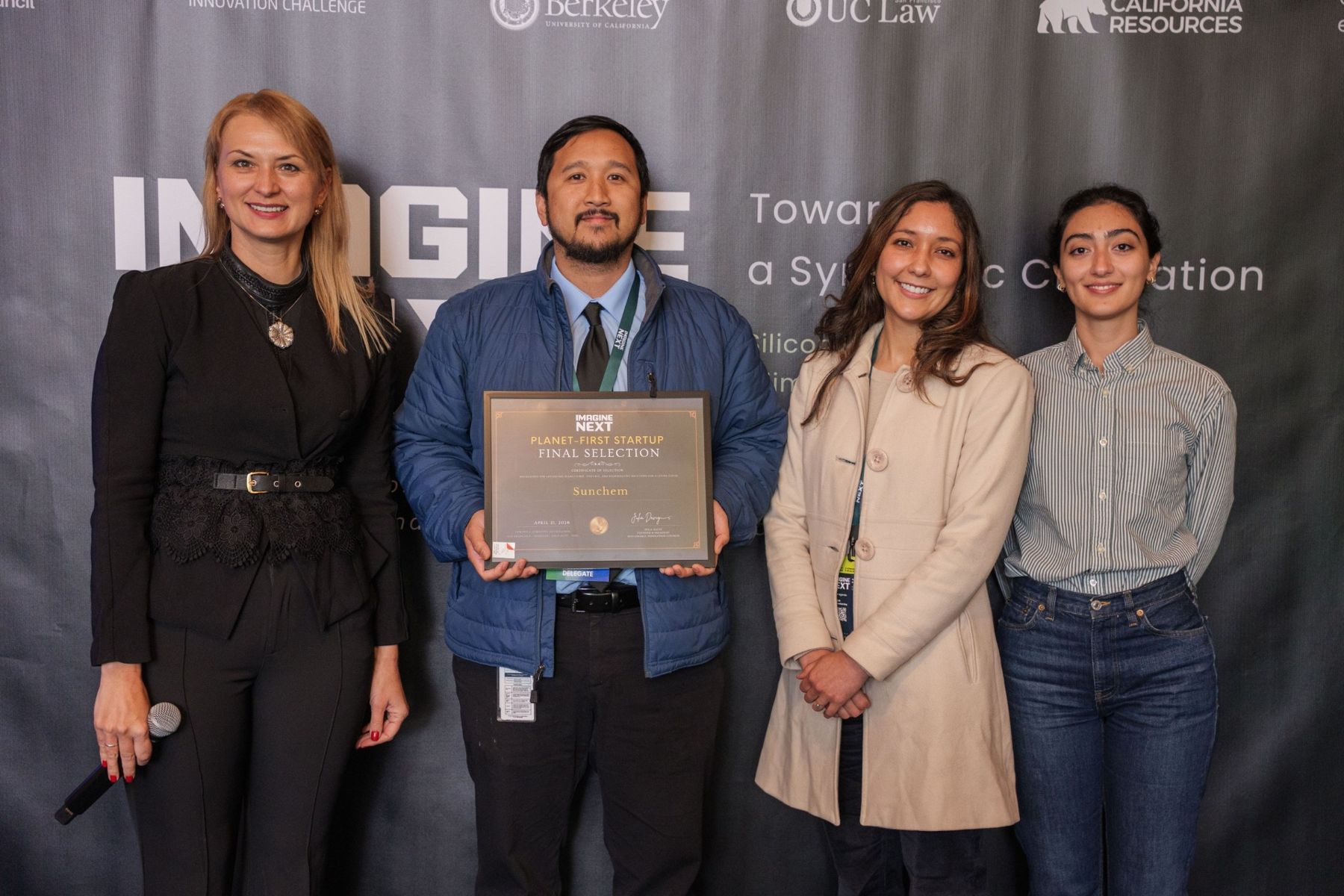
Sunchem
Critical metals recovered from waste streams.
2nd place
Airbuild Inc
Self-powered microalgae systems for wastewater and carbon capture.
3rd place
Rapid Analytix Division
Analytics for sustainable industrial systems.
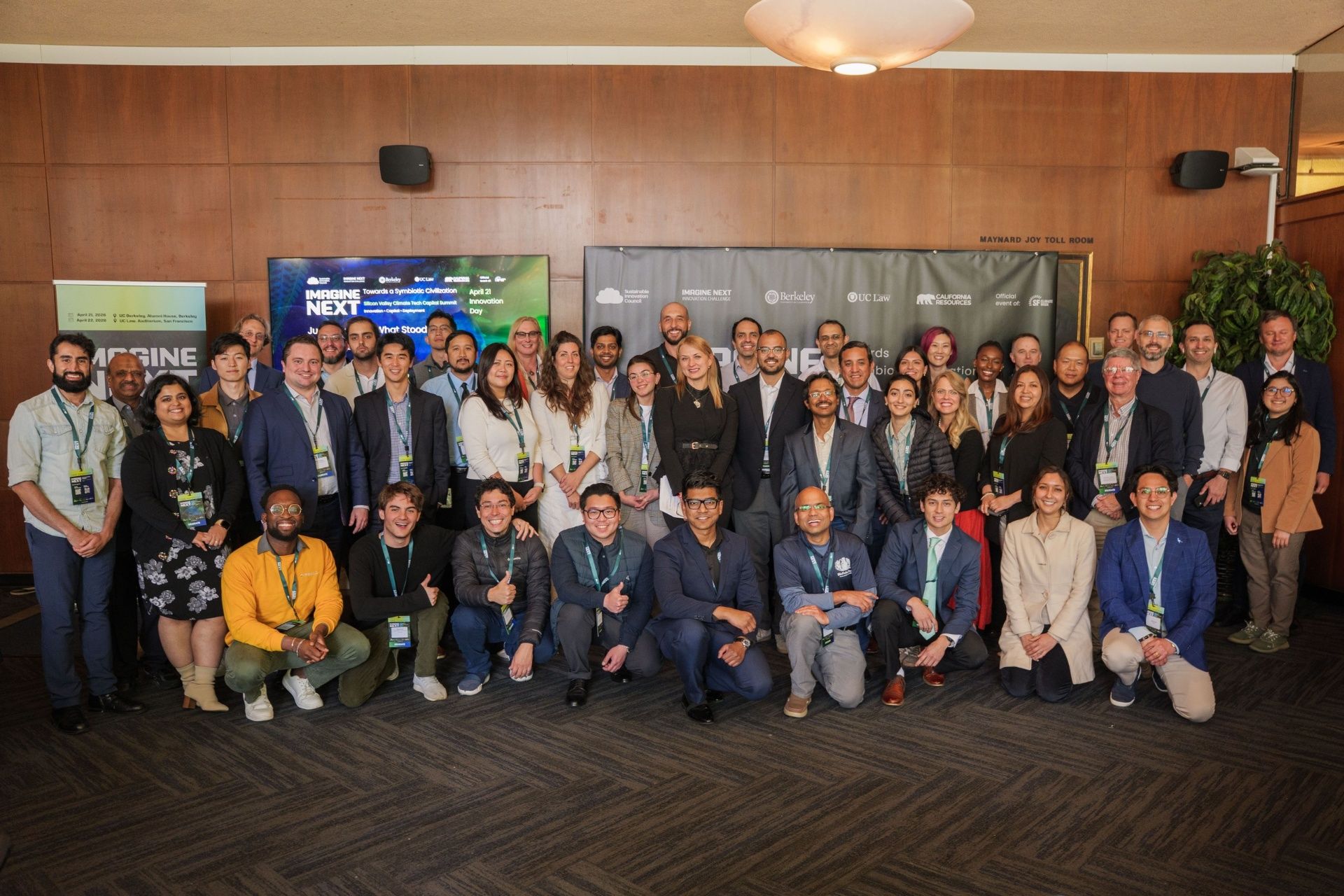
The 2026 Challenge is a finalist in the 6th Annual Anthem Awards, Industry Specific Program · Nonprofit.